

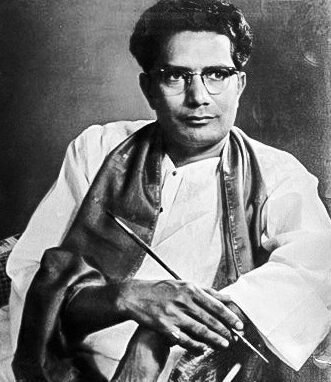
Abdulrahim Appabhai Almelkar (1920–1982) occupies a distinctive place in Indian modern art for his ability to harmoniously merge inherited visual traditions with a contemporary sensibility. Born on 10 October 1920 in Solapur, Maharashtra, he was trained at the Sir J. J. School of Art, graduating in 1948, where he received several awards and early recognition from institutions such as the Bombay Art Society and the Art Society of India. Deeply influenced by Indian miniature painting, mural traditions, and folk aesthetics, Almelkar developed a visual language marked by rhythmic line, balanced composition, and a refined sensitivity to pattern. His paintings empathetically depict rural and tribal life, reflecting a profound engagement with India’s cultural fabric while addressing modern compositional concerns. Alongside an active studio practice, he played an important pedagogical role, serving as principal of Nutan Kala Mandir in Bangalore and later returning to Sir J. J. School of Art as a lecturer in 1968. His work received further recognition from the Lalit Kala Akademi and was exhibited widely in India and across Southeast Asia, affirming his significance within and beyond the national context.
Style and Themes
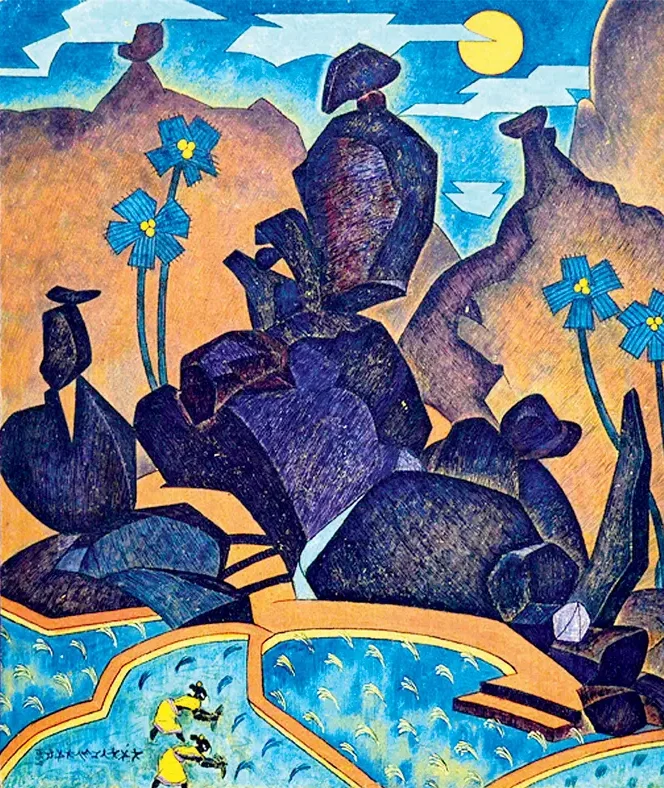
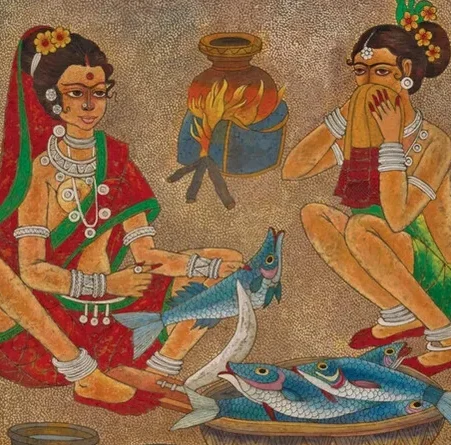
Almelkar’s work reveals a thoughtful synthesis of Indian miniature painting, folk art traditions, and modernist structure. Influenced by sources such as the Ajanta murals and regional visual cultures, his compositions are marked by deliberate linework, decorative surfaces, and carefully organized spatial rhythms. His subjects frequently revolve around village life, tribal communities, and everyday human interactions, treated with dignity and visual harmony.
Experimentation with materials was central to his practice, ranging from watercolour and ink on paper to tempera and mixed media, often applied with tactile methods that enhanced surface texture and expressive clarity.
Exhibitions
Throughout his lifetime, Almelkar participated in numerous solo and group exhibitions in India and abroad, helping broaden the reach of Indian modern art during the mid-twentieth century. His international exhibitions across Asia introduced audiences to his culturally grounded yet contemporary visual language.
Posthumous and retrospective exhibitions, including those organized by leading galleries, continue to reassess his contribution, reaffirming the relevance of his work within current art historical discourse.
Enduring Legacy
Almelkar’s artistic legacy lies in his commitment to reaffirming Indian visual traditions within a modern framework. His works are preserved in major institutional collections, including the National Gallery of Modern Art, ensuring continued engagement with his practice by scholars and curators.
Although less widely known than some contemporaries, his paintings remain significant for their nuanced depiction of Indian life and their role in expanding the vocabulary of modern Indian art.